Payroll Cost by Number of Employees
Most providers that list prices have similar pricing structures. You pay a monthly base fee and a cost per employee.
- Monthly Base Fee: Median of $50 on the lowest plan with tax filing (based on 22 providers, $19 to $180)
- Cost Per Employee Paid: Median of $6 (based on 20 providers, $2.17 to $75)
Taking these two medians ($50 + 10 × $6) for 10 employees gives us $110, which is only $2 off what we found in our cost scenarios.
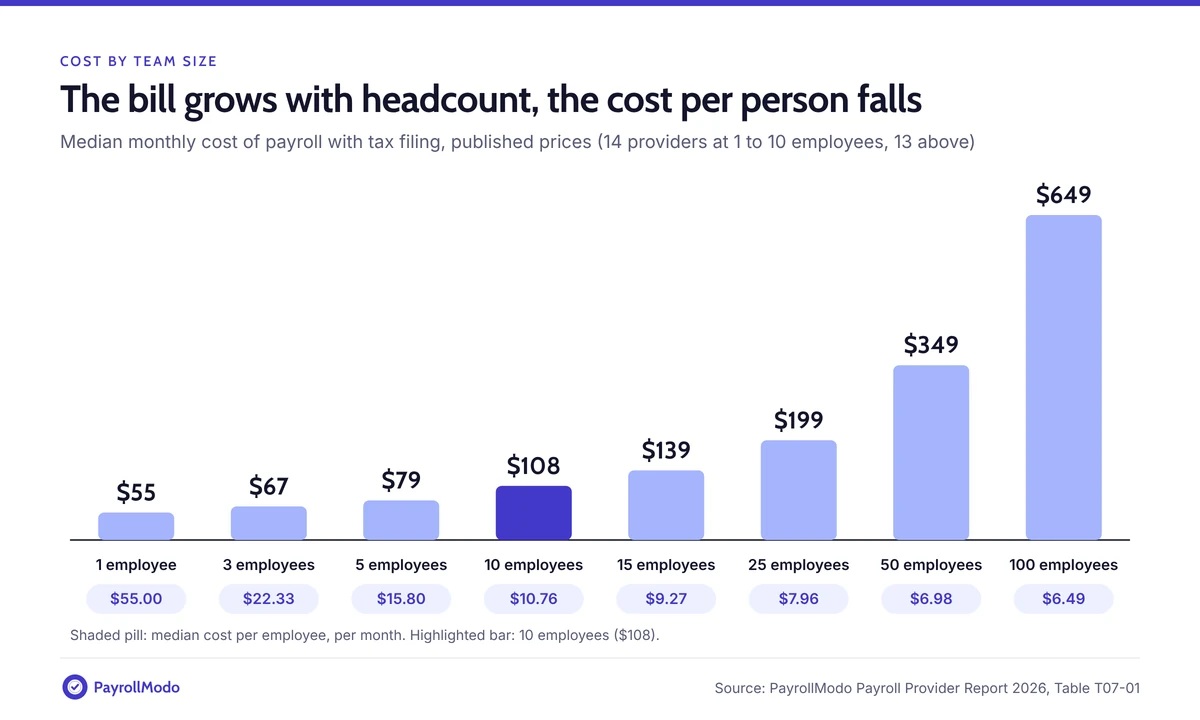
The table shows the cost at various team sizes. The median is the middle price, meaning half of providers charge less and half charge more. The range is the lowest and highest provider price.
| Employees | Median per month | Range | Per employee |
|---|---|---|---|
| 1 | $28 to $167 | $55.00 | |
| 3 | $32 to $168 | $22.33 | |
| 5 | $38 to $169 | $15.80 | |
| 10 | $50 to $222 | $10.76 | |
| 15 | $73 to $274 | $9.27 | |
| 25 | $103 to $380 | $7.96 | |
| 50 | $162 to $680 | $6.98 | |
| 100 | $262 to $1,280 | $6.49 |
The base fee is why the smallest teams will pay more per person. At one employee, you're paying a median of $55 a month.
When you get to 100 employees, you are paying $6.49 per employee, because the monthly base fee is divided among more people.
The chart shows both trends: your monthly cost goes up, but your cost per employee decreases.
What Makes Payroll Service Cost More
Headcount will determine your starting price. The factors in the table will affect your price as well.
For each factor, we used a sample company with 10 employees and its median cost of $108 a month. A plan upgrade means moving from the lowest plan to one that offers HR support, time tracking or benefits administration.
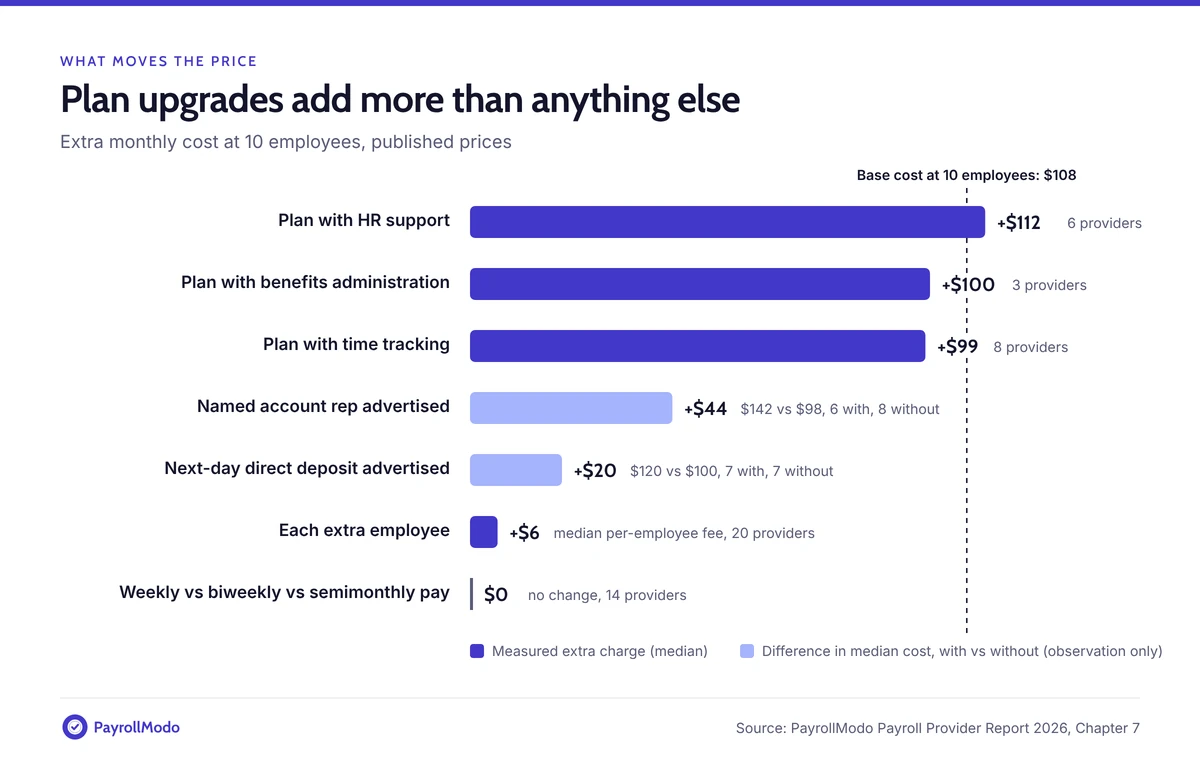
The table shows the exact numbers behind the chart. A plus sign tells you how much each factor costs per month. Rows marked "total" show what the monthly cost would be with that factor.
| Factor | Effect at 10 employees | Based on |
|---|---|---|
| Each extra employee | +$6 a month | 20 providers |
| Plan with HR support | +$112 a month | 6 providers |
| Plan with benefits administration | +$100 a month | 3 providers |
| Plan with time tracking | +$99 a month | 8 providers |
| Named account rep advertised | $142 vs $98 | 6 with, 8 without |
| Next-day direct deposit advertised | $120 vs $100 | 7 with, 7 without |
| 5 contractors added | $112 to $274 total | 7 providers |
| Employees in a second state | $82 to $222 total | 9 providers |
| Local income tax filing | $87 to $109 total | 3 providers |
| Weekly, biweekly or semimonthly pay | No change | 14 providers |
Plan upgrades add the most. If you choose any of the three upgrades, then it will almost double your $108 monthly cost.
We recommend you price out what you think you will need in one year instead of the lowest plan you begin with.
Your state can add a cost. Some states have local income taxes, including Ohio and Pennsylvania. Local tax filing didn't cost much when it was included in pricing.
The real question is whether providers offer it.
- 46% of local providers located in local-income-tax states advertise local tax filing (46 providers checked).
- 64% of national providers advertise local tax filing (36 providers checked).
How often you pay staff doesn't change the price. Weekly, biweekly and semimonthly payroll all came to $108 at 10 employees and $199 at 25.
We recommend you don't pay more to switch to weekly payroll.
Why You Pay More Than the Advertised Price
Pricing pages usually show a "starting at" price, which is normally just the base fee.
When you have 10 employees, your cost will be a median of $60 more per month than the "starting at" price (based on 14 providers with full published prices).
The gap is mostly due to the per-employee fee, which the "starting at" price does not include.
The chart breaks down the median cost for a company with 10 employees.
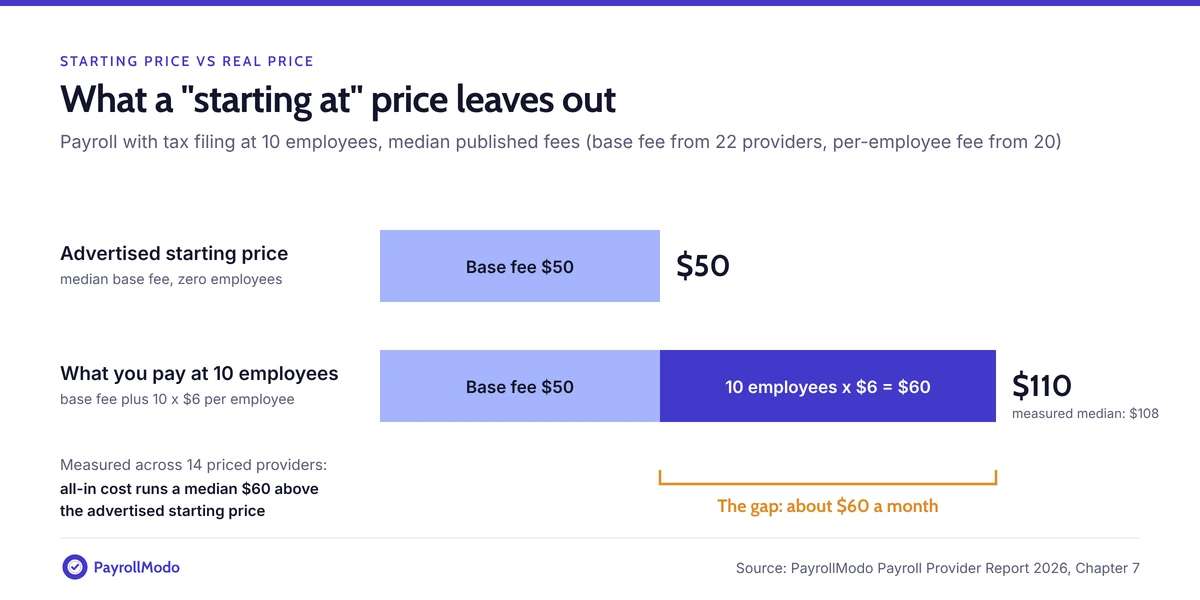
When a provider says "from $X" per month, assume that price is for zero employees. Take the per-employee fee and multiply it by how many employees you have, then add it to that price.
Most Payroll Companies Don't Publish Prices
If there is no pricing available, then you have to request a quote.
Out of the 195 providers we looked at, 13% had their full plan pricing available and 78% only give prices through a quote. Here is how that breaks down by provider type:
Most of the published prices come from national, software-driven providers. There aren't many full-service local providers with published prices.
For local providers that do have pricing listed, you can see they have higher base fees but lower per-employee fees.
- Local Base Fee: $75.83 (11 providers) vs. $49 for national
- Local Per-Employee Fee: $5.32 (8 providers) vs. $6.50 for national
Compare this fee pattern with your quotes. We recommend you don't eliminate any providers based on published price, since there aren't many local ones listed.
Extra Payroll Fees to Ask About
On average, the 195 providers we studied list 1.3 additional fees. National providers list 3.9. Local providers list 0.7.
For each fee in the checklist, over 85% of providers don't mention it. Just because a fee is not mentioned does not mean it's free.
Each box shows the fee, its price range and how many of the 195 providers charge it, say it's free, or don't list it.
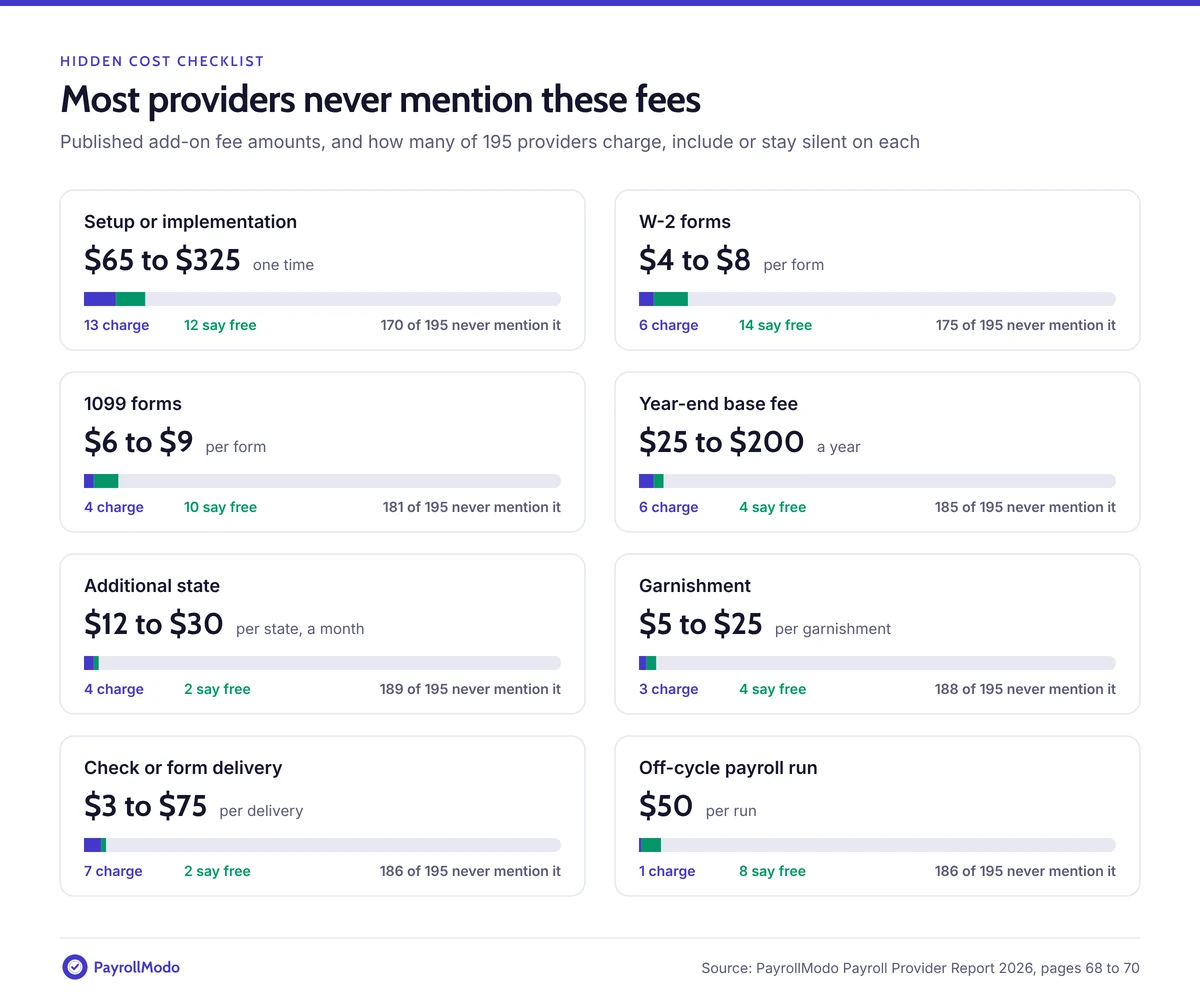
Here are those numbers in table form.
| Fee | Charge it | Say free | Published amounts |
|---|---|---|---|
| Setup or implementation | 13 | 12 | $65 to $325 once |
| W-2 forms | 6 | 14 | $4 to $8 per form |
| 1099 forms | 4 | 10 | $6 to $9 per form |
| Year-end base fee | 6 | 4 | $25 to $200 a year |
| Additional state | 4 | 2 | $12 to $30 per state a month |
| Garnishment | 3 | 4 | $5 to $25 |
| Check or form delivery | 7 | 2 | $3 to $75 |
| Off-cycle run | 1 | 8 | $50 |
If year-end form fees are charged, then you can expect to see them in January.
- With 10 employees, 11 out of 14 providers that list a price include W-2s in the cost of the plan.
- The remaining 3 charge a median of $80 a year for W-2s.
- With 25 employees, that median increases to $250.
Contract Terms That Raise Your Cost Later
Your contract will dictate whether your price can go up, whether it will auto-renew, and whether there is a cost to cancel.
Only 22% of providers said their service was month-to-month. Just 12% have a service agreement you can read before signing.
Of the 24 service agreements we read:
- 92% can raise prices
- 50% will auto-renew
- 50% mention fees when you leave
- 25% have an early termination fee or will charge you for the remainder of your agreement
For providers that list how much notice you need to give to cancel (15 providers), the median was 30 days and the longest was 90 days.
Only 3 out of 195 providers publish all four of these buyer-friendly terms: month-to-month service, no setup fee, no fee to cancel, and access to your records after you leave.
Some customers have already run into these issues when leaving.
In negative reviews that mentioned leaving, 18 out of 32 described being overcharged or hit with hidden fees.
Claiming no hidden fees did not lower billing complaints. There were billing issues in 17% of negative reviews that we read for providers that stated no hidden fees. Providers that did not say this had billing issues in 10% of negative reviews (based on 113 reviews for the first group and 343 for the second).
6 Things to Get in Writing Before You Sign
These are all things that most providers won't show on their website.
- Base fee and per-employee fee for the lowest plan that will file your federal and state taxes.The per-employee fee makes up most of the $60 difference between the advertised rate and the actual rate.
- All fees for setup, W-2s and 1099s, year-end forms, additional states and off-cycle runs.On average, providers show 1.3 of their additional fees on their website. If you ask, then they will tell you the rest.
- Price increase clause and length of contract in the agreement.92% of agreements published online allow price increases, and 50% auto-renew.
- What you will be charged once you cancel and how long you can view your records.Only 54% of agreements published online mention records access.
- Tax filing guarantee and what it can cover.Only 4% of providers will show you what the guarantee covers.
- Whether the provider will file your local taxes in a state that has local income tax.Not even half of providers in local-income-tax states will list local tax filing.
Where These Numbers Come From
All numbers come from the PayrollModo Payroll Provider Report 2026, which has 195 payroll-first providers (36 national and 159 local, covering all 50 states) researched on September 29 and 30, 2026. We went through every pricing page, compared plans and fees and looked at the services they list publicly. All costs are based on what is publicly available. Pricing is based on biweekly pay frequency, one state, W-2 employees and the cheapest plan that offers automated federal and state tax filings and year-end forms. Setup and year-end fees are divided across 12 months.
There isn't any public pricing for 100+ employees. Only 15 out of 1,823 reviews that we read mentioned a price, which is not enough data points to get an average. Our estimator fills in between the headcounts we measured. More info is on our methodology page.